Four Rooms, Four Clocks
Four facilities recorded events using different local clocks. Normalize their timestamps to determine whether the court's event order is supported.
Objective
By completing this module, you will be able to:
- convert local timestamps with signed UTC offsets to a common time zone; and
- defend an event order while preserving identifiers and elapsed time.
Before you begin
Open Four Rooms, Four Clocks and download the log. Review Time zones and offsets. Use a workspace that keeps the original timestamp beside each normalized value.
Concepts
A timestamp such as 2030-04-05 14:00 UTC+03:00 means the local clock is three hours ahead of UTC, so its UTC time is 11:00. For a negative offset, moving to UTC adds the offset's magnitude. Date boundaries may change during conversion. Only after every event uses the same time basis can you sort the chronology or calculate an interval.
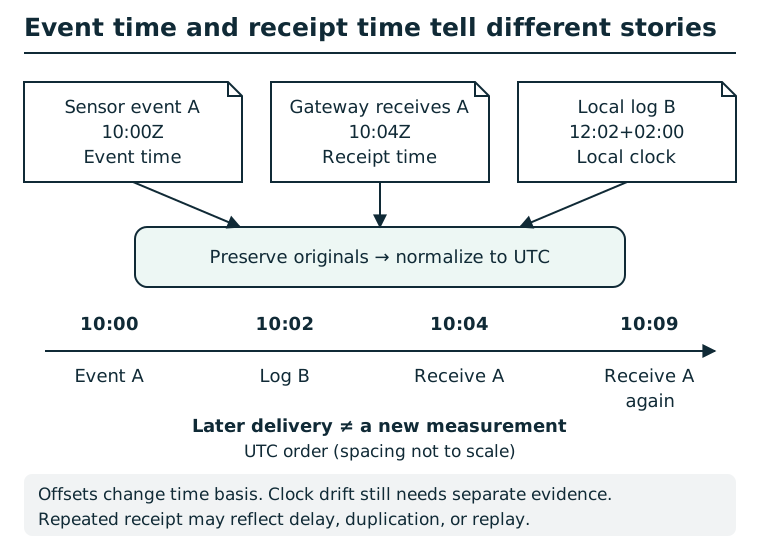
Keep event time, receipt time, source identifier, time-zone offset, and any known clock error in separate columns. In this synthetic example, the sensor's 10:00Z event is received at 10:04Z; a local log at 12:02+02:00 corresponds to 10:02Z. A second receipt of the same event at 10:09Z is not proof of a new event. Time-zone conversion does not correct clock drift; preserve uncertainty and corroborate replay before concluding it.
Suggested tools
- Timeline table: Use columns for event ID, original local timestamp, signed offset, normalized UTC time, and event description.
- Time-zone calculator: A trusted offline calculator can check arithmetic; paper calculation remains a suitable alternative for four records.
Tool practice
Rehearse the worked tool exercise before using challenge data.
Work the example that crosses midnight, then make one row per event with original date, local time, signed offset, and UTC result. Sort complete rows so IDs stay attached. Subtract UTC timestamps for an interval; do not subtract differently zoned clock displays.
Investigation
Observe
Inventory all event IDs, local dates and times, offsets, facilities, and event descriptions. Preserve the sign on every offset and watch for conversions that cross midnight.
Form a hypothesis
What is the earliest-to-latest order after normalization? Which pair of events determines whether a hold preceded an authorization export, and how long separates them?
Test carefully
Convert all four records to UTC before sorting. Submit the numeric suffixes of the event IDs—not the timestamps—in earliest-to-latest order. Record the order and requested elapsed interval separately in the case ledger.
Progressive hints
Hint 1
Do not compare the displayed clock faces directly; first place every event in one time zone.
Hint 2
Subtract a positive UTC offset from local time and add the magnitude of a negative offset. Recheck the date after conversion.
Hint 3
Sort the normalized rows, then copy only each event ID's numeric suffix into the form. Calculate the requested interval from the relevant two UTC rows.
Troubleshooting and reset
If your order is rejected, check each offset sign and any date rollover before re-sorting. Confirm that every suffix appears exactly once and that you entered suffixes rather than hours. A rejected chronology leaves the pane and ledger available for another evidence-based attempt.
Witness seal filing and recovery
Record this pane's critical finding in the active session before filing its witness seal. Supporting findings are optional. An unearned seal is rejected without consuming a failed-flag attempt. To recover an earned seal, revisit this pane or repeat the accepted finding in the same session; neither adds progress twice. All six critical findings and their six filed seals unlock release, seal, and return. Supporting findings strengthen the ending and remain available after it.